Chevy EVs and the Price of Gas: What You Actually Spend to Drive Electric
Gas is the cost you feel every month, and the question behind every EV test drive is simple: would going electric
actually shrink that number, or just move it to your electric bill? The answer depends on math you can check yourself, so
this page runs the actual figures.
Gordon Chevrolet prices every vehicle on its True Advertised Price: Real Prices, Real Payments, No hidden Fees. The same
standard runs this page. We won't quote you a savings number we can't tie to your driveway. What we will give you: the EPA
efficiency figures, what actually decides your monthly cost, and the free EPA tool that turns that into your own number.
What MPGe Tells You
The 3 Chevy EVs
What Sets Your Savings
Owning One Here
See What's in Stock
Frequently Asked Questions
What MPGe Actually Tells You
MPGe is the one number that translates EV efficiency back into terms a gas driver already understands. It stands for
miles per gallon equivalent: how far the EV travels on the energy in one gallon of gas, which the EPA fixes at 33.7
kilowatt-hours.
That makes the comparison apples to apples on energy:
Vehicle
EPA efficiency (combined)
Gas Equinox (FWD)
27 MPG
Equinox EV (FWD)
108 MPGe
The electric Equinox covers far more miles on the same energy. That gap is genuine, but it is only half the story. A
gallon of gas and a kilowatt-hour of electricity are priced differently, and both prices are local, so MPGe tells you
the EV is efficient while your own rates tell you what that efficiency is worth. The savings section works through that.
The 3 Chevy EVs, Sorted by How You Drive
Chevrolet builds 3 electric vehicles, and they split by how you use a vehicle: commute, family, or work. The table
sets out EPA efficiency and range; the notes say which fits your week.
Equinox EV
Blazer EV
Silverado EV
Best combined efficiency
108 MPGe (FWD)
104 MPGe (FWD)
64 to 70 MPGe
EPA range
Up to 319 mi
Up to 312 mi
283 to 493 mi
Built for
Daily commuter
Family hauler
Work and tow
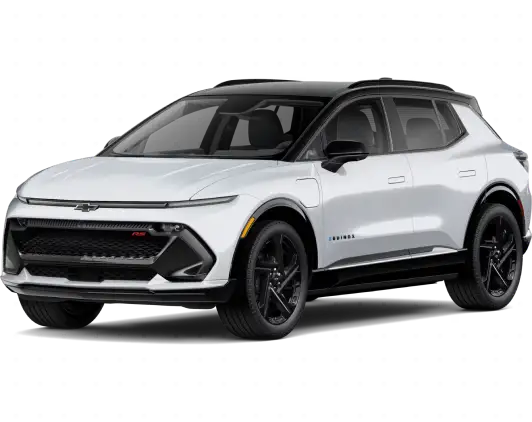
The Equinox EV is: the commuter pick and the efficiency leader, rated 108 MPGe combined with up to
319 miles of EPA range in front-wheel drive. For the daily run across western Wayne County, that range covers a normal
week between home charges. It starts at $34,995 MSRP at launch for the 2026 LT 1, $41,795 for the LT 2, and $44,095 for
the RS, each a True Advertised Price.
The Blazer EV is: the family pick, matching the Equinox EV's efficiency in a larger body: 104 MPGe
combined and up to 312 miles of EPA range in front-wheel-drive form, with room for car seats and a Costco run.
The Silverado EV: is the work-and-tow pick, and as a full-size electric truck it trades efficiency
for capability by design: 64 to 70 MPGe combined across its configurations, with EPA range from 283 to 493 miles
depending on build (Chevrolet quotes up to about 440 miles for the popular ones). It replaces a gas pickup without
making you plan your day around range.
If a lower price is the deciding factor, a more affordable Bolt returns for the 2027 model year at $28,995 MSRP at
launch, with up to 262 miles of EPA range.
Equinox EV prices are MSRP at launch for the 2026 model year, excluding destination; the returning Bolt figure is MSRP
at launch for 2027. Current pricing varies by configuration and program.
What Sets Your Savings
Your savings get decided in your driveway, not on a spec sheet: how far you drive, where you plug in, and how your
electricity rate stacks up against your local gas price. That is why 2 drivers in the same Equinox EV can land on
very different monthly numbers.
Lever
Why it moves your number
Your commute miles
The more you drive, the more often the efficiency gap pays you back. A short hop to work and a 40-mile round
trip on M-39 are not the same equation.
Home vs. public charging
Charging overnight at home is usually the cheapest energy a driver buys; leaning on public fast-chargers costs
more per mile. Where you plug in moves the math more than most people expect.
Your electricity rate vs. your gas price
Your kWh rate and your pump price are the exchange rate between MPGe and dollars, and both are personal to your
bill and your station.
There is one figure we can put a hard number on. The EPA estimates a 2026 gas Equinox (FWD) at about $2,300 a year to
fuel, the all-wheel-drive version about $2,400. Read the fine print, though. The EPA builds that on 15,000 miles a year
at a fixed national fuel price, so it is an estimate at the EPA's assumptions, not a Gordon Chevrolet quote, and your
figure shifts with your miles and your local gas price.
For the electricity side and your actual savings, the EPA's free fuel-cost tool at fueleconomy.gov lets you enter your
own miles, your own electricity rate, and your own gas price and compare these vehicles head to head. That figure is
yours.
Michigan winters are worth planning for: cold weather pulls range down on any EV, the same way it drops gas mileage. It
is a genuine factor on a January morning, not a reason the math stops working, and the EPA tool lets you account for
it.
Owning a Chevy EV at Gordon Chevrolet
Electric ownership changes the service relationship, so Gordon Chevrolet runs programs built for it:
Coverage built around the parts of an EV that matter most.
Gordon Chevrolet has sold and serviced Chevrolets across western Wayne County since 1983, and every electric model
carries the same
True Advertised Price
as the rest of the lot: Real Prices, Real Payments, No hidden Fees.
See What's in Stock and Run Your Own Numbers
When you are ready to move from math to metal, start with the model that fits how you drive:
Current deals change month to month, so they live on our
Chevrolet special offers
hub. And when you want a person to run your trade-in and a real payment with you,
contact our team
and we will put the numbers in front of you.
Frequently Asked Questions
The comparison rests on 2 numbers you already know: what you pay per kilowatt-hour on your electric bill and
what you pay per gallon at the pump. MPGe tells you the EV uses less energy to cover the same distance; those 2
prices tell you how much less that energy costs in dollars.
Run it on the EPA's free calculator at fueleconomy.gov: enter your mileage, your electricity rate, and your
local gas price for a side-by-side running-cost comparison of any of these vehicles. The result is built on
your inputs, not a national average.
For the daily commute, the EPA ranges sit well above what most drivers need in a day: 319 miles for the Equinox
EV, 312 for the Blazer EV, and 283 to 493 for the Silverado EV depending on build. A round trip on Ford Road,
I-96, or M-39 fits inside a normal week of home charging.
Cold weather is the variable to plan for. Michigan winters cut range on any EV, the same physics that makes a
gas engine work harder in January. Charging at home overnight means you start each cold morning full, which is
the simplest buffer the season offers.
You can charge on a standard 120V household outlet, but most Equinox EV and Blazer EV owners add a Level 2
charger (240V, the same as a dryer outlet) because it refills the battery overnight instead of over many hours.
GM Energy
is the first stop for equipment, installation, and rebate programs that offset the setup cost, and our
EV charging-times tip
lays out how long each level takes. Public fast-chargers handle road trips; for the lowest cost per mile day to
day, home charging wins.
It depends on you: how much you drive, whether you can charge at home, and how your local electricity rate
compares to gas. Drivers who commute regularly and charge at home see the clearest benefit, because the
efficiency gap is widest at high mileage and home electricity usually costs less per mile than gas. Drivers who
cover fewer miles, lean on public fast-chargers, or face high electricity rates may see little difference.
Neither outcome is wrong; it is personal to your situation.
The read that fits you is on fueleconomy.gov: enter your miles and your local prices. To run it with a person,
including your trade-in and a real payment, ask us to sit down and work the numbers with you.